

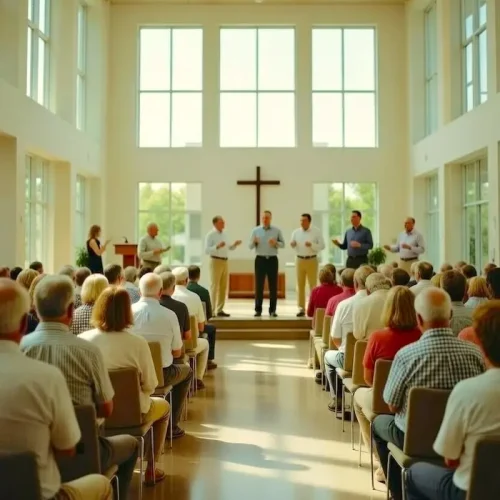
Years ago, joining a church might mean going through membership classes, or being interviewed by a church leader(s), signing a covenant filled with lots of promises, or simply making a profession of faith, & you’re “in.” If you came from a previous congregation, transferring to a new one might have involved securing a letter of recommendation to confirm that you had been a member in good standing.
But regretfully, people today generally prefer not to make such commitments, & churches don’t place much importance on it anymore. Due to modern mobility, logistical challenges, & varying standards, it’s difficult (especially in larger churches) to keep personal track of everyone, let alone vet them. Who even qualifies as an “active” member? Can members attend only once or twice a year to maintain formal affiliation? If they miss a few weeks or months in a row, could they be considered “inactive” members (whatever that means)? If so, it becomes a more-or-less meaningless thing, which is why some churches have done away with membership altogether.
But I maintain that membership is still vitally important. Besides the reasons mentioned in my last column (see it here), it’s good to deliberately move from church attender to church member because it provides accountability. In congregations like ours, anyone can attend or serve, but only members are eligible to hold formal leadership or teaching roles.
Membership means willingly coming under the Shepherds (Elders) of the church for sound teaching, spiritual guidance, pastoral care & accountability in living a Christ-honoring life. Members are also expected to support their leaders by supplying, praying for & encouraging them. These leaders keep watch over souls, & so it lets them know whose souls they’re accountable for (Acts 20:28-30, Heb. 13:7 & 17, 2 Tim. 4:2, 1 Thess. 5:12-13, 1 Tim. 5:17, 1 Pet. 5:2-3).
Without membership, how are Shepherds to know who is “in” their flock & who is an “outsider” (1 Cor. 5:1-13, 2 Cor. 2:6)? How will they know who they’re responsible to confront over continual sin or press for resolution of problems? A church can’t dismiss or “disfellowship” someone who was never a member to begin with (Matt. 18:15-17, 2 John 10, Titus 3:9-11).
Church members also have a say in affirming new elders or dismissing wayward elders. They may vote on other important matters such as annual budgets, bylaws, & real estate transactions. Of course, in some structures, the leadership doesn’t permit the congregation to have a say in important matters. This tends toward outside hierarchical control, or a completely top-down governance from within by a board, inner circle, or person.
For example, in the early Jerusalem church, the whole church got to choose men for a task in conjunction with the church leaders (Acts 15:22). A similar thing took place in Acts 6. But who makes up the “whole church”? It seems highly unlikely that it could be just anyone who wandered into the meeting that day. Not everyone who attends a church is even a Christian.
It’s similar to the concern about letting illegal aliens vote in our nation. They’re not citizens & may not even understand or share our Constitutional values. Without that kind of purposeful dedication & assimilation, they should not have a say-so in who government leaders are & how the nation is run. Should the world population have the right to move here at will & vote for whoever & whatever they want? That would destroy America.
Should non-Christians get to vote in a church? Should an influx of people with different doctrinal beliefs from another church or denomination have the right to migrate over & change the church’s beliefs? It has happened many times, especially in the 1960’s, with numerous non-denominational conservative churches like ours experiencing hostile takeovers. This was part of a “Restructure” that began years before by liberal leaders asserting control to turn these congregations into a mainline denomination. And, tragically, it worked. But conservatives filed lawsuits to protect some local churches’ autonomy & property.
Today, without a committed membership, leaders could turn the church in a completely different direction or introduce false doctrines. The people who attend would have no way to resist. The leaders could unilaterally kill the church & sell the property, or turn it over to another church or to a denomination for adoption, absorption, or merger. This happened not long ago to a church in our region. A different church in our region took a congregational vote to turn the church over to the control of a church located in a city many miles away. The vote failed by the narrowest of margins. But there were charges of improprieties about how the whole process was carried out, & who was really qualified to vote.
The church where I did my internship years ago was a solid, healthy, vibrant church. But it no longer exists because when a new minister was hired, he began concentrating power in himself, his wife, & select staff, while dissolving a larger governing board & altering operational rules without proper votes. He was also accused of engaging in improper financial dealings, including real estate transfers. A large group of members voted to remove him, but he refused to relinquish control & cancelled services indefinitely. Through lawsuits, the members eventually got control of the building back. But the damage had been done.
God forbid that anything like that should ever happen. Let the members of the church take their membership seriously to keep their congregation biblically faithful.