

This Sunday marks Southpoint’s 34th birthday! My wife & I started the church because our desire was (& is) to reach as many people as possible for Christ, & new churches are the most effective way! Since then we’ve experienced about every level of attendance there is—from zero to “megachurch” (at least for a while when it was still defined as over 1,000, & then it quickly came to be defined as over 2,000). We’ve been through single, double, & triple services; opening 2 more multisite campuses, & un-multisiting twice; rapidly increasing, plateauing, declining, slowly increasing, low snow days, pandemic shutdown, & Easter explosions of over 3,000.
But growing attendance can’t be the goal—it should be the byproduct of faithfulness to the evangelistic Great Commission (Matt. 28:19-20). Attendance isn’t something we can control anyway—that’s God’s job. What we can do is to be faithful in our own weekly involvement, & to pray for revival & awakening! We should all be intentional in sharing our faith & inviting people to come with us. Growing church attendance isn’t the only meaningful measure of spiritual health, but it is a powerful one that’s been counted since the book of Acts when attention was paid to the numbers of believers & how churches were increasing (Acts 2:41, 4:4, 5:14, 6:1 & 7, 9:31, 11:21 & 24, 14:1, 16:5, 17:4 & 12, 18:8).
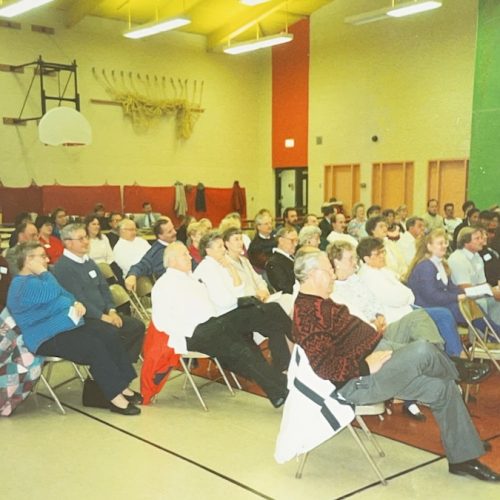
We had an amazing opening day with 257 for our “instant church” due to mostly inviting strangers by phone! As expected, though, with a from-scratch start, attendance quickly dropped in half, & then leveled out to around 100 people [as pictured], which was about the average church attendance in America at the time. It slowly grew to twice that size, & remained there for nearly a decade in a rented elementary school on a dead-end street. I had hoped to begin construction of a building by our 5th birthday, but it ended up taking twice as long. So our potential outreach was, no doubt, limited by our terrible location & people’s wariness of new churches without a building.
After we were finally able to afford property, & hold a groundbreaking, we began to increase. Before our grand opening in early 2003, we doubled. Soon after, we doubled again. We started constructing a phase 2 facility to accommodate more. When we moved into the current auditorium 3 years later, we again doubled in size. For the few years following these 2 building projects, our church was truly one of the fastest growing in the nation. We added a Saturday service which helped alleviate crowding for a while, but we were already considering further construction. By our 17th birthday, average attendance peaked at over 1,600. We weren’t just drawing in people from other churches because the number of conversions & baptisms was astronomical. How could we make room for more people to come to Christ & church?
What I learned long ago is that congregations tend to stop growing sometime between their 10th to 20th birthdays. If a church plant survives (some don’t), it can grow rapidly & then enter a period of plateau, & unless something dramatic happens, it inevitably enters a period of long decline & eventual death. There’s a bell-curve life cycle to churches just like any other living organism. After all, it’s unrealistic to expect a church to continue growing indefinitely, especially if the surrounding community isn’t growing. Detroit, of course, has been declining for decades, including Downriver.
But long story short, we chose the “multisite” route of becoming 1 church in multiple locations. We sent out a few hundred people to start new 2 new locations in our region in 2010 & 2015. The concept we learned about multisite churches was that attendance at the original location would likely be replaced by new people in all that freed-up space. But that’s not what happened. Those vacancies never did fill back up. But that was OK, because we were reaching new people in a new area.
However, leadership dysfunction & misalignment became exposed at all 3 locations, & momentum stalled. By God’s grace, we came through all those challenges to recover spiritual health. We released our 3rd campus to become independent just 3 ½ years after its opening. Then COVID-19 hit just before Easter of 2020, & we all remember what happened to churches then. Our attendance was cut in half, & Saturday services were no longer needed. It has taken all this time to slowly, steadily double again since Covid. Meanwhile, in a positive “un-multisiting” move, we released our 2nd location to become an independent church in 2023. Our attendance then returned to counting just 1 location.
In this century, church attendance has been noticeably declining, with the average now closer to 60 people per church than 100. Not only are fewer people attending due to secularization, but even those who do attend do it less often. Some may be watching services online, but most are not. Based on people’s own self-reporting, while 44% were attending “weekly or nearly weekly” in 2000, it has steadily & sharply fallen to just 31% last year.
But it’s even worse than we thought. Turns out those numbers are likely inflated because people tend to want to make themselves look more spiritual than they actually are. A 2019 study tracked actual cellphone location data from over 2 million Americans to see how often they went to a house of worship. Only 5% actually attended weekly (at least 3 out of 4 weeks). Let that sink in: 4 out of 5 people who say they go to church weekly don’t. 95% of Americans are NOT in church on a given Sunday. That’s not good.
But I’m not blackpilling. There are hopeful signs. There is some modest growth in many churches, while much of the decline is in theologically liberal & heretical churches. That’s a good thing. It also comes especially among Catholic churches.
I’m as committed as ever to seeing our church reach more people for Christ! It’s certainly a different & more challenging landscape than when we first started. But we never want to resort to unbiblical methods, gimmicky bait & switches, or watered-down biblical teaching to get more people in the seats. And we will never fear losing people because we’re standing uncompromisingly for biblical truth.