

You may be aware that Congresswoman Ocasio-Cortez is freezing her eggs so that she might have children later in life. That’s not a pro-life issue because an unfertilized egg is not an embryo. Eggs are not people; embryos are. We know some are confused by this because they think that breakfast eggs are pre-hatched chickens. But such eggs will never be chickens unless fertilized by a rooster. We oppose abortion not because it destroys eggs, but because it destroys people.
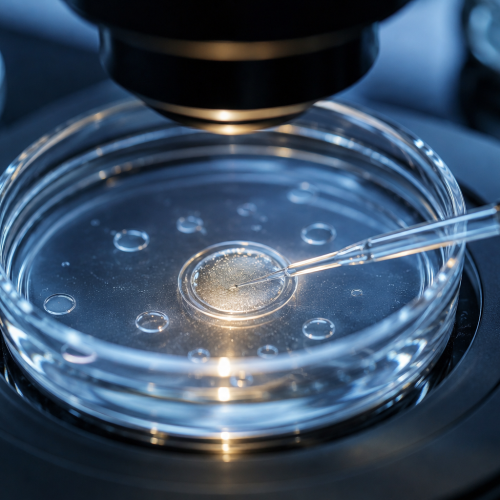
This is why it’s so confounding & disappointing that many pro-life officials are promoting In Vitro Fertilization (IVF) which is fertilizing eggs outside the womb in a test tube or petri dish for those who can’t conceive naturally. The goal is for more babies to be born, which is a good thing. Last year, President Trump took steps to make the very expensive IVF technology more affordable & accessible. But when he claimed, “You can’t get more pro-life than this,” he was way off.
Though an overwhelming majority of Americans see IVF as a morally good thing, it’s not just a harmless medical procedure. The IVF industry likely kills more preborn babies than the abortion industry. Some who are reading this may either be surprised by that, or even offended because they’ve participated in IVF treatments. The intent here is not to upset, but to help Christians think more deeply about what IVF is because I’d say few churches or ministers offer any moral guidance on it.
Of course, we want to be sympathetic & compassionate to married couples with noble longings for having children. Infertility can be heartbreaking. Bringing babies into the world is commended in Scripture as a blessing (Gen. 1:28, Ps. 127:3-5, Mal. 2:15, 1 Tim. 5:14). So when pro-life people who would never consider walking into an abortion clinic are understandably given hope by the promise of IVF, they may look past the ethics of what takes place in the laboratory. The end (a beautiful baby!) does not justify the means.
We absolutely want couples to have babies, but we should not be swayed from speaking out for fear of being labeled “extremists” or because of the compelling emotional claim that everyone is entitled to have their own baby. Good intentions can’t change what this under-regulated & dehumanizing industry has become. But hang tight, I’ll be concluding there is a moral way to do it.
Since human life begins at conception, each embryo is already a human at an early stage of development–a living, new, distinct, & unique person made in the image of God with his or her own DNA. That point has been made over and over in the abortion debate. The ordinary IVF process involves creating multiple embryos because not all will successfully result in pregnancy. The moral issue isn’t that some embryos may not survive the process, but that a “surplus” or “excess” of children are intentionally created than the parents are willing to welcome.They’re screened & graded to select the best candidates for implantation, leaving the others to be destroyed. The loss of an established pregnancy is a miscarriage–a natural loss. An embryo intentionally destroyed, however, is an abortion.
Sometimes people choose to freeze their embryos (not eggs), either for possible future use or, in some cases, to purposely abandon them in the hope that they will be adopted (“snowflake adoption is a compassionate act). But even some of these will not survive thawing. Some embryos may be donated for destruction in medical research & experimentation.
Which embryos are discarded like trash is based on the process of screening out any possible physical defects, such as is also done in abortions when preborn babies are found to have Down syndrome or some other genetic imperfection. Women often face great pressure to abort–you’re considered compassionate if you do, and cruel if you don’t. Embryo grading can be subjective, with even lower-graded embryos still resulting in successful pregnancies. Regardless, the question should not be, “Is this embryo healthy enough for us to want?” It should be, “Is this embryo human?” A child’s value & worthiness to be born doesn’t depend upon genetic quality (Ps. 139).
Embryos can possibly also be screened for maximizing probabilities of an ideal child regarding sex, height, intelligence, hair & eye color. There’s even a company called Nucleus IVF+ that lets you “pick your best baby.” But we call that “eugenics.” It’s not as sinister as the Nazis’ Aryan views, or the ableist, classist, & racist views of Margaret Sanger, founder of Planned Parenthood, but it can still encourage reproducing “superior” traits while discouraging or preventing those deemed less fit to reproduce. This raises a dystopian parallel to Huxley’s Brave New World.
So when 15 embryos are created in the lab, 12 to 14 will become unwanted or unused. Although current practice favors single-embryo transfer to the womb, in some cases more than one may be transferred as an “insurance policy” for a viable pregnancy. If all implants are successful a woman may say, “I only want to be the mother of one,” but the truth is, she’s already become the mother of 15. She’s just had her other unwanted children frozen or killed as medical waste or by “selective fetal reduction.”
The birth of one child doesn’t justify what happens to the other 14. They should not be created with the expectation that some will be sacrificed so that others can be born. Children should not be abandoned to a state of suspended animation indefinitely, denying them the opportunity to develop & be born as God intended. Yet, hundreds of thousands of such children are currently in deep freezer storage, often treated as property, without any rights, rather than as persons. Many wild bird eggs have more rights. These children deserve protection.
A genuinely pro-life form of IVF is radically different because it recognizes both the humanity of the unborn & the integrity of the family (we won’t here deal with the problems concerning the methods of procuring semen, or of treating embryos as commodities to be sold through surrogacy or to adopters who don’t constitute a husband-&-wife family). God wants children to be born to a mother & father committed in marriage. That may not be possible due to death or divorce, but it’s clearly God’s intention. So if a married couple uses IVF, they should only do so with the intent to fertilize as many eggs as they’ll allow to be born & welcomed as their children.
In other words, don’t create a child unless you’re prepared to give that child a chance to live & have a family. This may mean fertilizing & transferring only one embryo at a time, or no more than 3 at a time (if you’re capable of handling triplets). Push back on any doctor discouraging this & say, “We’re going to trust God.” However, this means less chance of success & more time & expense because it takes more tries. What’s more effective is less costly, & what’s less effective is more costly, which is why so few opt for that method. But it is the moral method.
Children who are born through IVF are precious, but their dignity doesn’t imply the moral goodness of the circumstances of conception. The same is true, for example, of children conceived out of wedlock (like myself)–we can rejoice in the child without celebrating the immoral conditions of conception. If you’ve participated in any such actions, whether you fully understood the moral implications or consequences or not, God invites you to turn to Him in repentance & experience His gracious forgiveness.