

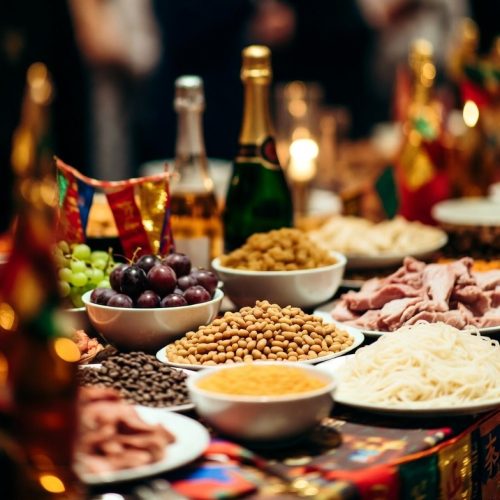
Did you gather to eat or drink something special for New Year’s Eve or Day? Many have such traditions & customs believed to bring prosperity, health, & longevity. Some foods are considered “lucky,” like fish, cornbread, & cabbage. In the South, they serve black-eyed peas. In Latin America, they eat 12 grapes at midnight. In Germany, Cuba, & parts of the U.S., they eat pork. In the Far East, it’s long noodles. Of course, many pop the cork & toast with alcohol at midnight (though it’s simply another excuse for many to get drunk).
These things may be fun or tasty, but they’re superstitions. Christians should have nothing to do with magical or even occult thinking. Instead, we trust in God’s control & goodness even in uncertainty. We pray for needs & guidance rather than relying on rituals. We give thanks for blessings, attributing them to God’s grace, not a directing force called “luck.”
What God calls us to do every Sunday is to share spiritually special food & drink in communion with Him & each other (Acts 2:42, 46, 20:7, 1 Cor. 11:20, 33). Jesus told us this is a participation of faith in remembrance of His body & blood given in sacrifice for us (1 Cor. 11:24-25). The elements of flatbread & grape juice aren’t talismans or lucky charms that automatically convey divine favor. Unbelievers may eat & drink, but receive no spiritual benefit. It may actually bring harm (1 Cor. 11:29-31).
Why does the Lord designate these consumable physical elements? God often uses tangible items to reinforce spiritual truths. He did this previously with altars, furnishings, & feasts, such as the Passover meal upon which the Lord’s Supper is based. Instituted by God at the time of the Exodus, the Israelites shared in an annual dinner of roasted lamb, bitter herbs, & unleavened bread—each item vested with symbolism of deliverance from slavery. Much later, rabbinic tradition included wine.
When Jesus shared this final Passover with His disciples, He revested the elements with new meaning (Luke 22:19-20). God sometimes attaches abstract concepts to something that can be seen, heard, smelled, touched, & tasted to help make them more “real” & memorable to us. Because eating & drinking are universal human needs, we understand more clearly how vital Christ is spiritually to our life, health, & growth. The blood color of the juice reminds us of His sacrifice, while the lack of leaven (yeast) reminds us of His sinlessness, since leaven can be associated with corruption & negative influence (1 Cor. 5:6-8, Matt. 26:28, 16:6).
The ordinary elements of bread (wheat) & grapes were staples of life in ancient times, & still accessible to nearly everywhere in every era. You’ll notice Jesus didn’t command eating lamb as part of communion like it was for Passover. Why? For one, Jesus Himself is our Passover lamb (1 Cor. 5:7, 1 Pet. 2:22). For another, lamb isn’t universally accessible in the same way wheat & grapes are. So, as far as possible, the food & drink Jesus used shouldn’t be substituted with something else like popcorn & Pepsi.
Jesus said to do “this” in remembrance of me—that is, what He’s specifically doing. So we faithfully continue to eat & drink. We don’t use some other mode of participating, such as inhaling or injecting (1 Cor. 11:24). But we have freedom to use whatever form of unleavened bread we choose—matzah, tortilla, pita, or roti. We could use large hand-broken pieces of fresh-baked flatbread, machine-cut mini wafers (the kind that look like Chiclets), or prepackaged kits.
We have freedom to use wine, grape juice, or alcohol-free sparkling wine—though I believe the case can be made that Jesus deliberately used “fruit of the vine” or “cup” instead of “wine,” which He easily could have done. But if wine was used, it likely would have been diluted with water. In today’s context, it seems wiser to use grape juice so as not to create a stumbling block of temptation to drunkenness & underage drinking, or raise objections from conscientious teetotalers (Rom. 14:13).
We also have freedom in incidental features not connected to the meal’s meaning. The elements can be passed in trays by multiple men & women, distributed only by deacons, personally handed out by one individual, or set out on tables for self-serve. To demonstrate unity, most traditional churches serve the elements from one literal communion table, though the imagery is missing of everyone reclining around the table like Jesus & the disciples (1 Cor. 10:21). And even then, the table Jesus used was likely a three-sided one (a triclinium).
Scripture mentions “one loaf” demonstrating our unity, though any church with more than a few dozen people can’t logistically use just one literal loaf (1 Cor. 10:17, Luke 22:14). And though Jesus passed a single cup to be shared, it would seem we have freedom to use many cups since “cup” can mean the contents, not the actual container (Ps. 23:5, John 18:11). It’s similar to how we say, “He drank the whole bottle” (rather, what’s in the bottle). Using individual cups is also wiser & more loving to avoid spreading germs.
Like on New Year’s, the Lord’s Supper is a special time of serious reflection & resolve to do better, & a time of celebration, looking forward to better things to come (Matt. 26:29, 1 Cor. 11:26). In this new year, prioritize this communal food & drink as your new tradition every week.