

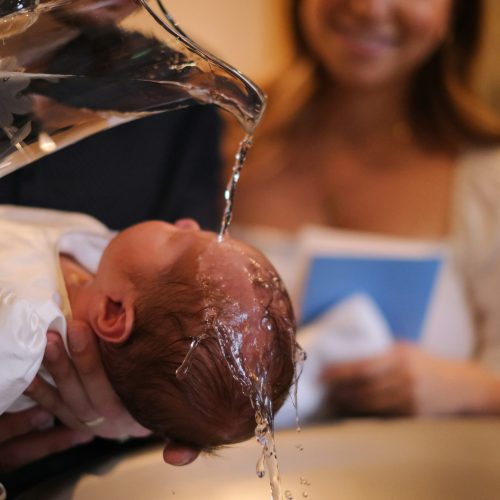
This question touches a nerve for many because it involves matters of faith, family traditions, & strong feelings. But our primary concern should be: What does the Bible say? We can’t debate personal experiences–we can only deal with what God has said, & the New Testament never tells us to baptize babies, nor is there even one example of it. If it were so important, wouldn’t we see at least one mention of it? The Bible says nothing about the human inventions of christening & confirmation.
History tells us that infant baptism was introduced much later. It didn’t even become officially approved by the Roman Catholic Church until the Council of Ravenna (A.D. 1311). During the late 4th & 5th centuries, the theologian Augustine laid the foundations for infant baptism because he said people inherit the guilt of Adam & Eve’s original sin. While it’s possible that Scripture suggests people inherited some kind of sinful nature or propensity toward sin, it does not say we’re born sinful.
Sin is defined as something willfully done in defiance of God’s commands (1 John 3:4). Death is earned like a paycheck for deeds done, in contrast to eternal life which is bestowed freely (Rom. 6:23). When you stand before God, you’ll have no one to blame for your sin but yourself–not your parents or ancestors (Ezek. 18:20). Jesus declared that God’s kingdom belongs to little children & those like them (Mark 10:14). They don’t need to be saved because they’re not lost yet.
Some teach that baptism replaces Old Testament circumcision. But nowhere does the New Testament teach that. There are too many differences for it to be a parallel ceremony. The sign & seal of our adoption into God’s family is not baptism, but the Holy Spirit (Eph. 1:13).
Some try to point to household conversions in the book of Acts, claiming that if entire families were baptized, there must have been babies or young children present. But that’s a baseless assumption. In Scripture, only those who were able to believe were baptized (Acts 8:12, 18:8, Mark 16:16). For example, the jailer’s whole family had come to believe after hearing Paul’s message (Acts 16:34). “Faith comes from hearing the message” (Rom. 10:17). Can babies respond to messages?
Baptism requires personal faith–not parental proxy. Someone has insightfully pointed out that God only has children, not grandchildren. It’s not a ritual, but an appeal to God (1 Peter 3:21). Infants don’t appeal. It would be similar to dragging someone off the street & throwing him into water. Is he truly baptized? Of course not! He had no choice. Infants have no choice either.
God doesn’t hold us accountable for sin until we’re old enough to understand personal sin & faith. What is that age of accountability? The Bible’s not clear on that. It certainly has to do with each individual’s maturity, intellect, upbringing, & opportunity. What biblical teaching have they been exposed to? What “light” has been available?
Some children who grow up in Christian households tend to reach that age sooner. Others who grow up never hearing about the Bible or God, still develop a moral conscience. They eventually will rebel & recognize they’ve disobeyed the Lord even if they don’t know Him personally. Some who are mentally challenged may grow up & never reach an age at which they become accountable. They’re still innocent in God’s eyes because they don’t understand what sin is.
The question of children being baptized is tied into the nature of baptism itself. The word “baptize” (“baptizo” in Greek) means to immerse. Nowhere in Scripture do we find the words for “sprinkling” (“rantizo”) or “pouring” (“cheo”) used for baptism. If only Bible translators would actually translate the word instead of transliterating it, there would be no controversy. Can we afford to take it upon ourselves to redefine a word that Jesus & the Apostles used repeatedly?
The only sprinkling in which we participate is an inward one. Hebrews 10:22 makes the distinction between having our hearts (not bodies) sprinkled (with the blood of the sacrifice, that is, Christ) & our bodies washed with water. These two events occur in baptism.
Immersion is the biblical model as even Jesus, Himself, went to a place where there was lots of water so that He could go down into the river & then come up out. (Matt. 3:16, John 3:23). The Ethiopian also went down into the water & came up out of it (Acts 8:38, 39). Only Immersion gives us the picture of dying & rising with Christ (Col. 2:12, Rom. 6:3-6).
You may hesitate, wondering, “If I get immersed, won’t it cause a problem with my parents who had me sprinkled?” Maybe. But you can express that while you’re grateful they did what they believed was right in good faith, you’ve studied the Scriptures for yourself & are convinced this is what God says to do.
“Wouldn’t being immersed be a judgment that I wasn’t already saved?” No. If you’ve been following God’s will to the best of your ability, then whenever you encounter something in the Bible that you should do, a humble & willing heart is ready to do it. You’re only admitting you haven’t fully understood God’s plan, but now that you do, you’re ready to take that step & appeal, “Lord, do for me whatever you haven’t already done!”
I would hope no one would ever try to sit on God’s judgment throne & say someone who sincerely accepts Jesus in good faith, but hasn’t been immersed, is condemned. Mark’s Gospel prevents us from saying that, while also offering a promise of assurance: “Whoever believes and is baptized will be saved, but whoever does not believe will be condemned” (Mark 16:16). We don’t know the circumstances–were they aware of what baptism is & means? Had they been taught incorrectly?
In rare instances when a believer honestly desires to be baptized, but is prevented for some reason (confined to a hospital bed, in prison, on a battlefield), it’s reasonable to assume God counts the will for the deed. But that’s not an excuse for anyone else not to be immersed. Immersion brings a sense of assurance & completeness because we know we’ve done what God has said. We cannot change the Bible or the covenant Christ offers.