

Perhaps the most tragic thing that has crippled Christianity is the departure from the biblical plan of salvation. If there’s one area all Christians ought to be unified in, it’s the Gospel & how to respond to it.
The Gospel is Jesus accomplishing salvation through His death, burial, & resurrection, & offered to us by grace (1 Cor. 15:2-4, Rom. 3:23-24). God’s terms for receiving His gift are shown in many places in the New Testament: Believe in Jesus (John 3:16), repent of sin, & be baptized for the forgiveness of sins & the gift of the Holy Spirit (Acts 2:38). The Apostle Paul even stressed that our unity is shown in our one Lord, one faith, one baptism (Eph. 4:5).
Over time, several shifts led to a departure from apostolic teaching. Baptism became viewed so strongly that it began to be seen as something that brought regeneration in a kind of sacramental way instead of a believer’s response to God’s grace. A sacrament was thought to confer grace by the act itself, though Scripture emphasizes faith & repentance as prerequisites (Rom. 10:17, Acts 3:19). That view gained prominence in the 4th century through Augustine’s influential theology, which viewed infants as born guilty of sin & unable to respond to the Gospel due to the consequences inherited from Adam.
This led to the practice of infant baptism. Faith & repentance no longer needed to precede baptism. Instead of people hearing the message of Christ & responding, infants could be baptized without any personal decision. To accommodate infants, sprinkling was introduced instead of immersion, which is what the Greek word (“baptizo”) means. Baptism no longer marked the moment of conversion, but meant the baby of a believer was automatically incorporated into the Church.
As the Roman Catholic Church developed, it built this sacramental system into something even more unbiblical by teaching that God infuses grace through other means, such as Confession/Penance, the Eucharist & Extreme Unction (Last Rites). The institutional church was now the mediator of these sacraments. This tended to add good works to salvation, which contradicted salvation by grace (Eph. 2:8-10).
In the 16th century, the Protestant Reformation swung the pendulum in the opposite direction. The Reformers objected to such a works-based system, & so sought to restore salvation by grace through faith. But they often redefined baptism. Martin Luther held on to the biblical teaching that baptism is connected to salvation, but he unfortunately also held on to the Augustinian idea of original sin. Since Luther rightly affirmed that faith should precede baptism, he speculated that God must gift the babies of believers with faith. Faith was something divinely granted, not an act of human will. Though he admitted that New Testament baptism was immersion, he also held on to infant sprinkling.
Others, however, would throw the baby out with the bathwater. Instead of making baptism overly important to salvation in a sacramental sense, they made it overly unimportant by unhitching it from salvation altogether. When those who adopted Calvin’s Reformed theology, which said that salvation is by grace alone (as opposed to meritorious acts) through faith alone (adding the word “alone,” which the New Testament does not), they also adopted the view of a theologian named Zwingli, who said baptism is merely spiritual & symbolic. Since baptism is something a person “does,” they classified it as a human “work,” so it could have nothing to do with salvation, even though Scripture clearly says it does (Mark 16:16, 1 Pet. 3:21, Acts 22:16, Rom. 6:3-4). They also continued infant sprinkling.
While some groups, such as the Anabaptists & Baptists, recovered believers’ baptism by immersion as the biblical model, they, too, separated it from salvation. Baptism was instead seen as a post-salvation act of obedience signifying that a Christian was already saved, instead of it being the time & place when salvation was ordinarily received. It became regarded as merely a public testimony of faith – an “outward sign” of an inward grace – though Scripture never describes it that way. They still considered it important, but in no way essential.
This is what led to baptism being considered by Protestants & Evangelicals as an “ordinance”–a special action ordained by God to be observed, similar to taking communion. But Scripture never calls baptism an ordinance nor connects it to any other act of observance or obedience following salvation. The plan of salvation became a matter of “accepting Jesus as your personal Savior,” or “inviting Jesus into your heart,” or “praying the sinner’s prayer.” Not only do these practically omit repentance from the plan, but Scripture never expresses our response in those terms.
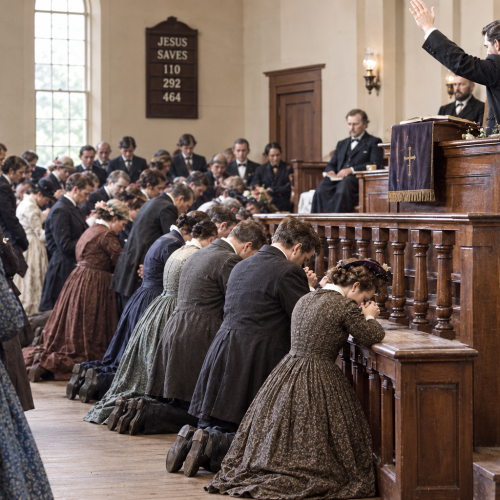
During the Second Great Awakening in the early 1800s, revivalism introduced the “mourner’s bench” (or “anxious seat”) where people were invited to come forward & “pray through” until they experienced emotional relief & a sense of confirmation about salvation. In practice, this public altar call largely took the place of baptism as the visible demonstration of faith.
So into this confusing variety of understandings came the Restoration Movement in the early 19th century, which began restoring the biblical plan of salvation, especially the role of baptism. Early leaders such as Alexander Campbell countered Augustinian/Calvinistic teaching by saying babies are not born into sin or into faith (as other free-will groups also asserted). Salvation doesn’t happen automatically or mystically independent of faith. Faith is mental assent to the Gospel – an act of the will to trust Christ – not necessarily an emotional decision made at a “mourner’s bench.”
This led Campbell to reject infant baptism since there was no faith or repentance in it, nor any New Testament example or command for it. Baptism was neither sacramental nor symbolic – it was to immediately follow belief in order to receive the promises of forgiveness & the gift of the Holy Spirit. I’ll continue next time with the story of this recovery, leading to what I came to develop as “The 3’s Plan of Salvation.”