

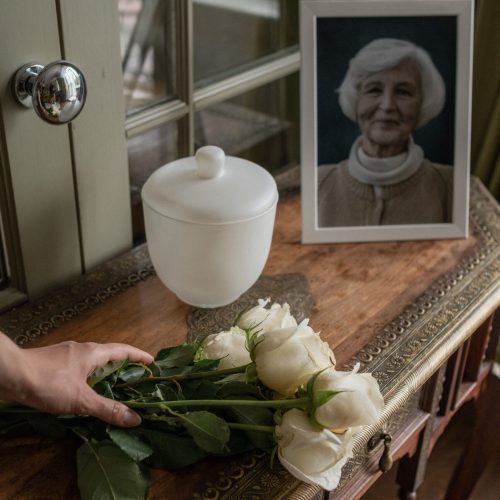
Someone stopped me recently at church to ask whether cremation was acceptable for Christians. It’s a question that’s been asked more frequently because of the huge cultural shift in attitudes toward cremation. It used to be generally discouraged & rare in Christian societies. In 1960, less than 4% of deaths in America resulted in cremation. Even as late as 1980, it was 10%. But statistics from a decade ago showed for the first time it became the preferred choice of the majority. Today 2 out of every 3 are cremated rather than buried. That’s a very dramatic reversal.
What caused this shift? Traditional burial has become expensive. In Michigan, the average cemetery costs alone – grave, opening & closing it, burial vault, & a simple grave marker – can be up to $10,000 (which has increased by $3,000 over the past decade). Meanwhile, a direct cremation typically costs around $2,000.
But cost isn’t the only reason for the shift. With families scattered across the country, cremation allows for memorial services to be held at a more flexible time for gathering. But an even bigger factor may be changing religious attitudes. For 2,000 years, Christians overwhelmingly practiced burial. Cremation has been historically discouraged & even banned by some churches to reflect both respect for the body God made & confidence in the future resurrection of the body. But not only are fewer Americans influenced by Christian traditions, many denominations no longer discourage it or even take a position on it.
Eastern Orthodox & some conservative Christian groups still overwhelmingly encourage burial because of its biblical symbolism, but don’t necessarily treat it as sinful. Since 1963, Roman Catholicism has permitted cremation, provided it’s not chosen as a denial of belief in the resurrection. It’s also become commonplace among Mainline Protestants & even among Evangelicals.
But what does the Bible actually say about it? Nothing – at least in terms of commands. Abraham buried his wife in a cave. Moses, too, was buried, but as a unique situation since God Himself did it (Deut. 34:5-6). Those are descriptive examples, not prescriptive commands & so are not morally binding.
When King Saul and his sons were killed by the Philistines, their bodies were burned by the Israelites, & then their bones were buried (1 Sam. 31:12–13). But this, too, was an unusual circumstance, perhaps because their bodies had been badly abused. Most references to burning bodies in the Old Testament are negative, connected to judgment & disgrace. Denial of proper burial was seen as a tragedy & dishonor. Even among the pagan peoples (Canaanites, Egyptians, Assyrians, & Babylonians), burial was the usual custom. But later in the Greco-Roman world, cremation became commonly practiced by pagans.
Jesus was buried – not in the ground, but in a tomb: “They took the body of Jesus and bound it in linen cloths with the spices, as is the burial custom of the Jews” (John 19:40). The early Church continued with burial as the normal practice. Even as the Church became overwhelmingly Gentile, they rejected cremation, & even spread burial into Roman culture. Baptism, as our entry into the new life of Christ, is a portrayal of death, burial, & resurrection (Rom.6:3-4, Col. 2:12).
But does a body need to be buried to affirm belief in bodily resurrection on the last day (1 Cor. 15:42-44)? I don’t think so because no matter what, a material body is going to decompose – dust to dust (Gen. 3:19, Ecc. 3:20). Some bodies perish by fire (cremation merely accelerates the natural process); some are lost at sea & dissolved; others get left out in the open, exposed to scavengers. Whatever happens to the body after death, the soul is with the Lord (2 Cor. 5:8, Phil. 1:23). No matter what the condition of a corpse, God is able to raise it & transform it into a new, glorified resurrection body!
In the same way, organ donation, whether before or after death, does not detract from the resurrection. In fact, it can be a very positive thing, expressing Christian love by giving life & hope to those suffering from serious illness. Donating your body to medical science can be a charitable act as well, benefiting countless people. These can be acts of selfless stewardship of the bodies God has entrusted to us.
So while some have strong personal convictions & preferences, we can’t say there are Scriptural prohibitions on cremation. Because Scripture is silent about it, we have to leave it as a matter of opinion & Christian liberty (Rom. 14). It’s up to each Christian’s conscience. God doesn’t say it’s a sin, but if a Christian considers it a sin, he shouldn’t do it or else he’d be sinning against his conscience. Nor should he judge another Christian because cremation can be done reverently & with dignity. The method seems to be neutral; what matters most is the motive – is God being honored & resurrection hope still being expressed?